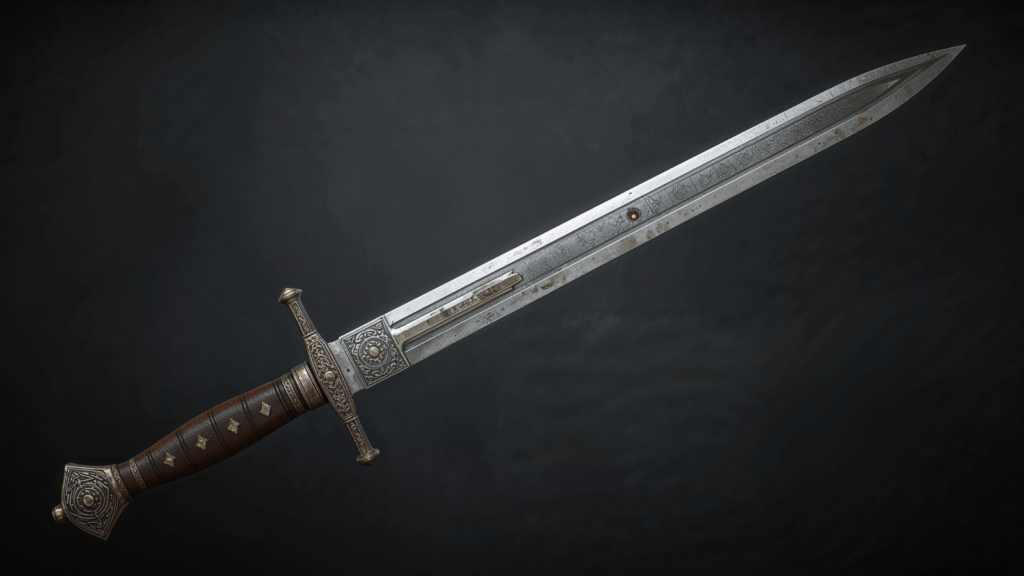
The falchion sword was used in Europe and it could be wielded with one hand. The falchion’s shape is very much the same as that of the Persian scimitar and yet it manages to offer the weight and power of an axe as well as the sharpness of a sword. The medieval Falchion had a single-edged blade cut in a curve, and the European version had a back edge that was shorter and thinner. It was 37-40 inches long and weighed about 1-2 pounds.
Usually, falchions were made with a single edge on the blade near the tip and most of them had a crossguard for the hilt. This was similar to the one used in swords. However, unlike double-edged swords, a very few examples of this type have survived up to today.
The Origins of the Falchion
The falchion, a new sword with a single-edged blade, emerged in Europe sometime in the 12th century during the period when swordmakers began to experiment with different sword techniques. While the knights’ straight longswords were powerful weapons, the falchion’s single edge plateaued at the tip and slashed only. It outdone slashing as it cleaved along the line of impact, as an executioner’s axe in a grandeur of wrapped.
The falchion’s lethal quality was not only about its technical characteristics but also its intended imbalance. With its wide belly, the sword was designed that way to ensure the wielder gets maximum following through even after delivering the cut. The impact was so powerful that even with very light armor, the blow could easily render the enemy unfit for fighting or even death. The conical shaped-hilt gave the fighter control signifying that medieval artisanal skills were equal to those of engineers in their artistic crafts.
Different types of the falchion, for example, the beautiful Italian Storta, the large English Conyer Falchion, and a number of others, were made in different locations in Europe according to the particular fighting styles and the conditions of the battle. Nevertheless, they all had a common goal of making the dispute short and clear-cut.
The falchion blade designs underwent considerable changes in the course of history as well as across the continent. There are two main types of falchions that can be identified:
- Cleaver falchions
- Cusped falchions
New research keeps improving the classification of the falchion blade styles. The classification has divided all known falchions into five main types (1-5) and also five curvatures.
Why Knights Favored This Unusual Blade
The longsword’s blade with its duality showed discipline and balance and was meant for the knights who had mastered the complex art of swordplay. The falchion, on the contrary, was better on the battlefield, where chaos ruled and the sharpshooter was done by instinct.
The longsword’s central balance gave rise to smooth motion and defense, while the falchion’s tip-heavy blade punished hesitation. A longsword could remove one’s weapon, while a falchion could break through the guard. One was a mark of the aristocracy; the other—the stark truth. Still, the swing of a falchion in the right hands is a conversation about weight, gravity, and intent.
The falchion, though brutal, was still a symbol. In medieval paintings it often appeared as the weapon of choice for saints, angels, or kings in their struggle against evil as a tool of divine justice in the world. The curved blade, which could mean both mercy and punishment, was imagined to separate the blameless from the wicked. It was, in effect, the sword of judgment.
Reforging History — The Modern Falchion
Steel forms the handle of the River Yare falchion, which is then anti-slip leather wrapped around to make sure that it does not slip while one is using it. The wooden scabbard is then leather-covered and fitted with stainless steel and the unseen side of the blade is thus well protected. A belt is also included for easy carrying.
The River Yare falchion weighs just 1.425 kg (3.142 lbs) and measures 84 cm (33.1 in) in total length, thus being light and fast enough for the battlefield. The 66 cm (26 in) long blade and 14 cm (5.5 in) location of the point of balance provide an advantage in switching between the more durable and less controlling parts of the weapon, thus, advantage in mobility and control, and even the hands of the user are protected.
Medieval Extreme’s production of the Messer sword with a scabbard was done with the intention of not only meeting the league’s standards but also of pleasing the armored combat lovers. The scabbard features a wooden base as its foundation. It receives a layer of premium leather and is adorned with stainless steel trims for added durability and longevity.
Craftsmanship and Balance in Every Strike
The modern falchion has not lost the magnificent violence of its medieval counterpart and is thus by now found in the armored battle fields of the present. It is light but the blade’s front weight still tells of its striking power being equal to its agility and steel made handles are leather covered with material that has anti-slip properties.
The past is disclosed: the assortment of falchions at Medieval Extreme which are based on the contemporary steels are the only remains for the future and they are all created with the qualities of control, balance, and impact being the main focus. Get the most out of the personalized consultation we have and become a part of history.