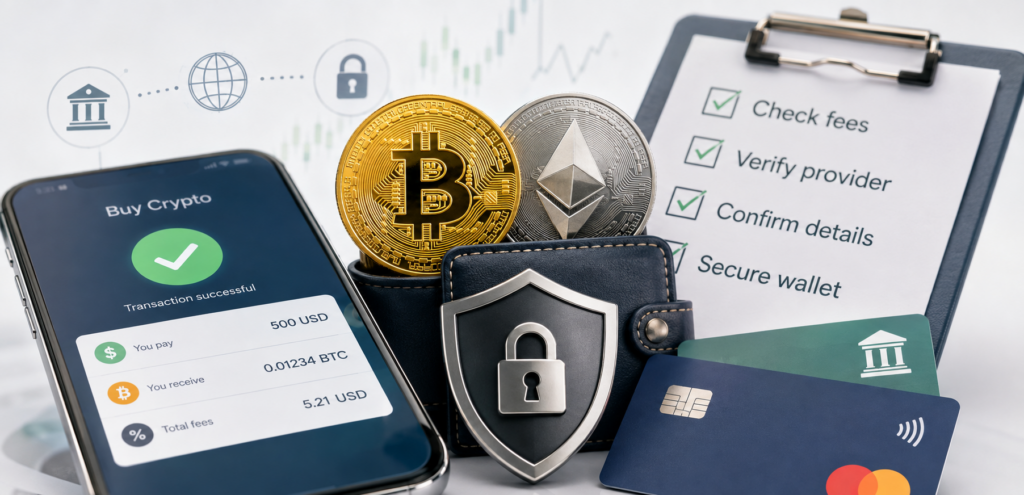
Buying crypto safely now involves more than choosing an asset and entering a card number. Fees vary by payment method, providers operate under different rules and a simple mistake with a wallet address or blockchain network can make a transfer irreversible. What should buyers check before they confirm a crypto purchase?
Calculate the Real Cost of Buying Crypto
The price shown for a crypto purchase can differ from its final cost. A buyer should account for the quoted exchange rate, spread, service fee, payment charge and any network or withdrawal costs before comparing providers.
The Fees Behind a Crypto Purchase
The spread directly affects the conversion rate. A platform can show a low transaction fee while offering a less favorable rate, leaving the buyer with less crypto for the same fiat amount. Payment costs depend on the funding method, while network fees vary by blockchain and network activity.
|
Cost |
What affects it |
What to check |
|
Spread |
Quoted exchange rate |
Fiat paid vs. crypto received |
|
Service fee |
Provider’s pricing model |
Fixed or percentage charge |
|
Payment fee |
Card, bank transfer or processor |
Additional fiat cost |
|
Network fee |
Blockchain and activity |
Applicable network |
|
Withdrawal fee |
Provider’s terms |
Cost of moving funds |
Recurring costs also matter for people who use crypto services regularly. If frequent purchases or swaps make a subscription worthwhile, users may get more benefits with ChangeNOW Pro subscription than by paying for individual services separately. The right comparison is therefore between the subscription cost and the benefits it provides over the period of use.
Card, Bank Transfer, and Other Payment Methods
The payment method can affect both the final cost and the time required to complete a purchase. Card payments offer convenience, while bank transfers may have lower fees in some markets. Available methods and their costs depend on the provider, currency and user’s location.
The most useful comparison is the final amount: how much fiat leaves the buyer’s account and how much crypto arrives after all applicable charges. Looking at these figures together gives a more accurate measure of the effective purchase cost than relying on a headline fee alone.
Check the Platform Before Sending Money
Before sending funds, verify who operates the service and what happens to your crypto after the purchase. In the EU, this also means checking whether the provider falls under the relevant MiCA framework. ESMA maintains a register of authorised crypto-asset service providers and certain non-compliant entities, giving consumers a practical starting point for verification.
Verify the Provider
Check the legal entity, jurisdiction and services covered by its authorisation. A regulatory badge on a website is only useful when it matches the actual company and activity. The SEC’s 2025 case involving the purported platforms Morocoin, Berge and Cirkor shows the risk of taking such claims at face value: regulators alleged that the scheme used fake crypto trading platforms and misappropriated more than $14 million from retail investors.
Independent reviews can provide another layer of due diligence when they examine a platform’s operating model, custody arrangements and limitations. A non-custodial exchange review, for example, can help clarify how a wallet-to-wallet service handles user funds compared with a conventional custodial exchange.
Understand Custody
Custody determines who controls the assets after a transaction. A custodial exchange manages wallet infrastructure and account access, while self-custody leaves the private keys with the user.
The FTX collapse showed why this distinction matters. Customers who expected to be able to withdraw their assets faced severe restrictions when the exchange failed, while self-custody carries a different set of risks because access depends on the user’s own keys and recovery credentials.
Before buying, therefore, identify where the crypto will sit after the transaction and who controls access to it. That decision determines a significant part of the user’s responsibility once the purchase is complete.
Protect the Transaction From Common Mistakes
Once the provider and purchase terms are clear, the main risks shift to fraudulent payment instructions and errors in the transaction itself.
Before Confirming the Payment
Scams often appear at the point when users are ready to send funds. Fake support messages can request payment to a new wallet, while fraudulent websites can imitate legitimate services.
A 2025 SEC case involving Morocoin, Berge and Cirkor illustrates the risk. Regulators alleged that the operators promoted fake trading platforms through social media, displayed fabricated balances and demanded additional payments before withdrawals. The alleged losses exceeded $14 million.
Payment instructions from unsolicited contacts deserve independent confirmation, especially when they involve a new wallet address.
Before Sending Crypto to a Wallet
Before confirming a transfer, check:
- Asset: the correct token.
- Network: a network supported by the recipient.
- Destination: the correct address, plus any required memo or tag.
A small test transfer can verify the details before sending a larger amount. Blockchain transactions generally cannot be cancelled after confirmation, so an incorrect address or unsupported network can leave funds inaccessible. Crypto payments also usually lack the reversal mechanisms available with traditional payment methods.
A final check of these details before confirmation can prevent an irreversible mistake.
Three Scenarios for Buying Crypto Safely
The safety and predictability of a crypto purchase also depend on conditions outside the transaction itself. Regulation can change which providers serve a market, while volatility, payment infrastructure and blockchain activity can affect how a purchase is executed.
Base Scenario
In the base case, regulated providers continue operating under clearer rules and major payment channels remain available. The EU’s MiCA transition period ended on July 1, 2026, so providers relying on transitional arrangements now need the required authorisation to continue serving EU clients.
For buyers, the practical effect is a clearer regulatory framework when assessing providers. The price of an asset and conditions on a particular blockchain can still change during the transaction.
Optimistic Scenario
The process could become easier as banks, payment processors and crypto providers standardise their compliance procedures. Clearer fee disclosures and better transaction interfaces would help users understand what they are paying for and reduce avoidable mistakes.
Wallet interfaces are another area with room for improvement. Clear network labels and stronger transaction confirmations can make errors less likely, especially when the same asset exists across several blockchains.
Stress Scenario
A sharp market move can change the value of a purchase while a payment is processing. Network congestion can increase transfer costs or delay confirmation, while restrictions from banks or payment processors can interrupt fiat funding.
Fraud adds another risk during periods of market excitement. The FTC reported $7.9 billion in consumer losses to investment scams in 2025, with crypto frequently involved in reported cases.
Under these conditions, the practical question becomes whether the transaction can still be completed on the terms the buyer accepted. Checking the quoted conditions before payment and allowing time for verification gives the buyer more control when external conditions become less predictable.
A Safer Crypto Purchase Starts Before You Pay
The strongest protection comes from decisions made before the transaction is confirmed. Knowing the full cost, understanding who handles the asset and checking the final transaction details can prevent mistakes that become expensive or irreversible.
Crypto markets will keep changing, as will regulation and payment infrastructure. A careful buyer cannot control those conditions, but can control how much uncertainty is accepted before money is sent.
FAQ
What is the safest way to buy crypto?
Use a reputable provider, check its regulatory status where relevant and review the full transaction terms before paying. Keep control of your account or wallet credentials and verify transaction details before sending funds.
Which payment method is best for buying crypto?
There is no single option for every buyer. Bank transfers may cost less in some markets, while cards can offer greater convenience, so compare the total cost and processing conditions for the specific transaction.
What fees should I check before buying crypto?
Look at the spread, service fee, payment charge and any applicable network or withdrawal costs. The most useful figure is the amount of crypto you receive after these costs.
Can a crypto transaction be reversed?
Confirmed blockchain transactions generally cannot be cancelled. An incorrect wallet address or unsupported network can therefore make funds difficult or impossible to recover.
How can I avoid crypto purchase scams?
Use the provider’s official website and verify payment instructions independently. Be especially cautious with unsolicited support messages, guaranteed returns and requests to send crypto to a new wallet address.
Disclaimer
This article is for informational purposes only and does not constitute financial, investment, tax or legal advice. Cryptocurrency involves market, security and operational risks, and readers should assess their own circumstances and conduct independent research before making any transaction.