Ask any truck owner about their worst day and a fair number will describe the same scene: a wreck that was not their driver’s fault, a four-wheeler darting across two lanes, and then a claim that says it was the truck’s fault all along. Without proof, the bigger, heavier vehicle usually loses that argument by default. The repair bill, the premium hike, and the reputation hit all land on you, even when your driver did everything right.
A dash cam for your truck flips that script. It is an impartial witness that never blinks, never forgets, and never gets rattled on the stand. This guide walks through what a truck dash cam actually does, the types and features that matter, how AI-powered cameras go beyond simple recording, and how to roll them out across a fleet without a fight from your drivers or your budget.
Why a Truck Needs a Dash Cam More Than Any Other Vehicle
Trucks are big, visible, and an easy target. When something goes wrong on the road, the truck gets blamed first because it is the most imposing thing in the frame. That bias shows up in police reports, in insurance adjustments, and in jury rooms. The only reliable counter to assumption is footage.
There is also the staged-accident problem. Commercial trucks are deliberately targeted by people looking for a payout, because they know the carrier carries serious insurance. A dash cam turns a he-said-she-said into a clear video record, and a clear video record makes a fraudulent claim fall apart fast. For a fleet, that protection compounds across every mile every driver runs.
The Types of Truck Dash Cams
Road-facing (single-lens) cameras
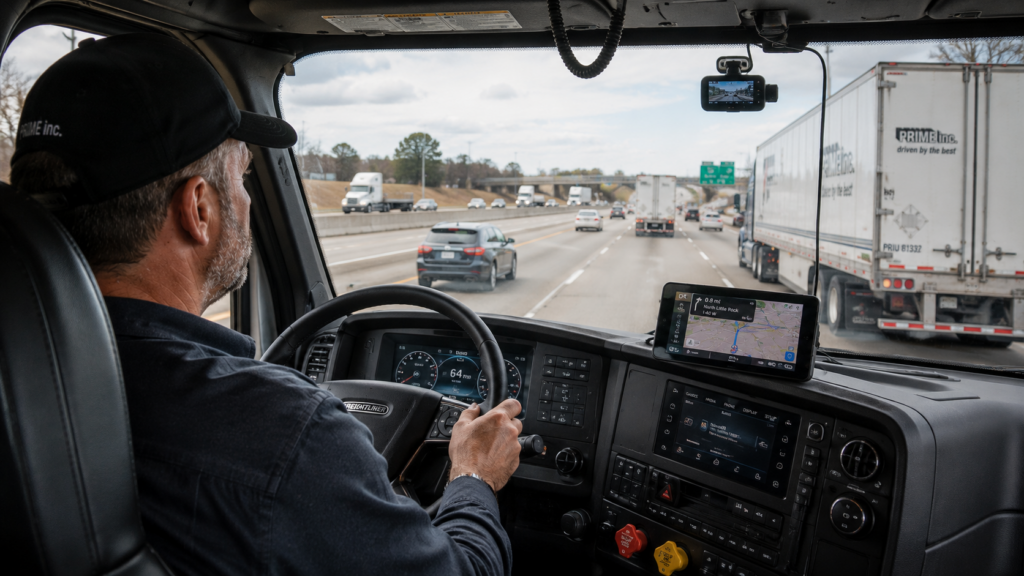
The basic build captures the view through the windshield. It records the road ahead, which is exactly what you need to prove fault in a front-end collision or a cut-off. For owner-operators who mainly want protection against false claims, a road-facing camera covers the most common scenario at the lowest cost.
Dual-facing cameras
These add an inward lens pointed at the cab. The road view protects the driver against other motorists; the cab view shows what the driver was doing in the moments before an incident, which protects you against the claim that your driver was distracted. Dual-facing is the standard for fleets that want a complete picture and the strongest possible defense.
Multi-camera systems
Larger trucks have blind spots that a single forward lens cannot cover. Multi-camera setups add side and rear views to capture lane changes, backing maneuvers, and the angles where a lot of disputes actually happen. For box trucks, flatbeds, and anything where the back end is a liability, the extra angles pay for themselves the first time they clear a driver of blame.
AI Dash Cams: Beyond Just Recording
The newest generation of fleet dash cams does more than store video for after the fact. AI-powered cameras analyze what is happening in real time and act on it, which moves you from reacting to incidents to preventing them.
Real-time driver alerts
AI cameras can detect distraction, drowsiness, phone use, and following too closely, then alert the driver in the moment with an audible warning. That in-cab nudge corrects the dangerous habit before it becomes a crash, which is worth far more than the clearest footage of an accident that already happened.
Automatic incident capture
When the camera detects hard braking, a collision, or a sharp swerve, it automatically flags and saves that clip and can push it to you immediately. No more scrubbing through hours of footage to find the ten seconds that matter. The system surfaces the events worth your attention on its own.
Coaching that sticks
Footage tied to specific events gives you something concrete to coach with. Instead of telling a driver to be safer in the abstract, you can show them the exact moment they followed too closely and talk through it. That specificity is what actually changes behavior, and safer behavior is what lowers your crash rate and your premiums.
Modern fleet dash cams bring this AI layer together with cloud video and proactive alerts, so the camera is not just a black box you hope you never need. It is an active safety tool working every mile.
What a Truck Dash Cam Actually Saves You
Lower insurance and faster claims
Insurers increasingly reward fleets that run dash cams because tracked, recorded drivers are lower risk. And when a claim does happen, handing over clean footage shortens the dispute and protects your premium from the increase that follows a fault finding. Over a fleet, the savings on premiums alone can offset the cost of the cameras.
Protection against fraud and false claims
The staged accident, the phantom injury, the claim that your driver ran a light that was actually green, footage kills all of them. One avoided fraudulent payout often covers a fleet’s worth of cameras several times over.
Exoneration that protects your drivers
Your drivers carry the stress of knowing that any incident could be blamed on them unfairly. A dash cam that proves they were not at fault protects their record and their livelihood, and that protection is one of the more underrated reasons good drivers stay with a fleet that runs cameras.
A safer, more accountable fleet
When drivers know the camera is rolling and that coaching is fair and footage-based, driving habits improve across the board. Fewer hard-braking events, less speeding, fewer close calls. That cultural shift toward safety is the long-term return that keeps paying after the hardware is bought.
Handling the Driver Pushback
The inward-facing lens is where some drivers get nervous, and that is worth addressing head-on rather than steamrolling. The honest framing is that the camera protects them more than it polices them. The overwhelming majority of footage that ever gets pulled is footage that clears a driver, not footage that gets one in trouble.
Rolling cameras out well looks like this:
- Be transparent about why the cameras are going in: protection first, coaching second, and never a gotcha.
- Show drivers real examples of footage exonerating a driver, so they see the upside firsthand.
- Use coaching as a conversation, not a punishment, so the cameras build trust instead of resentment.
- Make clear that the goal is sending everyone home safe, which is a goal drivers share.
Choosing a Dash Cam Provider for Your Trucks
The camera hardware matters, but the company behind it decides whether this becomes a reliable safety system or a frustrating one. Look for these before you commit.
- Integrated GPS and video, so location data and footage live in one platform instead of two disconnected tools.
- Cloud storage and easy retrieval, so you can pull the clip you need from your desk, not by physically grabbing an SD card.
- No long-term contracts, so you are not locked in if your fleet or your needs change.
- Real human support, because when a camera goes offline, you want a person, not a ticket queue.
- Hardware that ships fast and installs without a multi-week appointment backlog.
Pairing dash cams with GPS fleet tracking in one system is where the real value lies. You get the where and the what together: location, route, speed, and the footage to match, all in a single view built for transportation, logistics, and trucking operations.
Getting Cameras in Your Trucks
A dash cam rollout should be measured in days:
- Talk through your fleet and your biggest risk points with a real expert.
- Match the right camera, road-facing, dual-facing, or multi-camera, to each truck.
- Install fast and connect the footage to your tracking platform.
- Set your alerts, brief your drivers honestly, and start protecting them mile one.
BrickHouse GPS pairs AI fleet dash cams with tracking under one roof, ships most devices within 48 hours, and backs the hardware with a lifetime warranty on an active plan and real human support. No long-term contract required.
The Bottom Line
A dash cam for your truck is the cheapest insurance against the most expensive day. It protects your drivers from blame they do not deserve, protects your business from fraud and inflated premiums, and quietly makes your whole fleet safer in the process. The trucks are already on the road taking the risk. A dash cam just makes sure the truth is on your side when it matters.
Ready to put a witness in every cab? Get clear pricing and talk to a real person about the right dash cam setup for your trucks. No contract. No hold music.