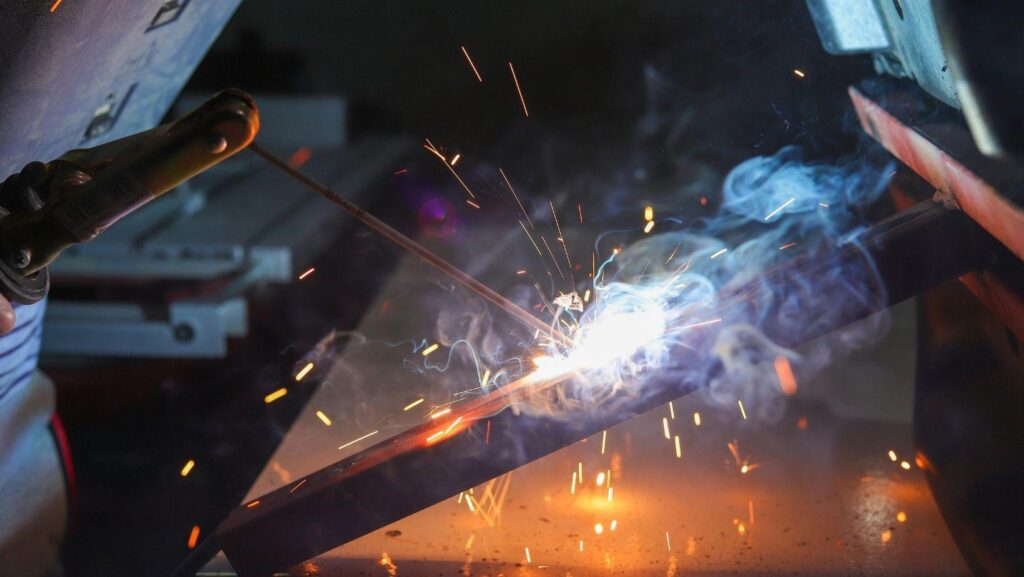
Advanced welding processes can extend component life up to 10 times over conventional repairs, but only when matched correctly to failure modes and operating environments.
When a critical wear plate fails for the third time in 18 months, the problem is rarely the welder’s skill. The problem is process selection. Conventional MIG or stick repairs deliver fast turnarounds and familiar pricing, but they cannot address root cause failure on components in high-abrasion, high-corrosion, or high-temperature environments. The result is a costly cycle: patch, fail, patch again.
Breaking that cycle requires matching advanced welding techniques to specific failure modes and operating conditions. GTAW (TIG) welding handles exotic materials and code-compliant precision repairs. Plasma Transferred Arc Welding (PTAW) delivers wear life extensions in abrasive environments where conventional overlays fail. Submerged Arc Welding (SAW) ensures structural integrity on large components without sacrificing quality or timeline. What follows is a superintendent’s guide to defensible repair decisions backed by cost-per-hour data and documented procedures that satisfy both CFOs and compliance audits.
Understanding Failure Modes Before Selecting a Welding Process
Conventional stick or MIG repairs fail on industrial components because the process does not match the failure mechanism. A standard electrode applied to a chute liner does not address abrasive wear from bauxite slurry. A MIG weld on duplex stainless does not replicate the corrosion resistance of the base material because the filler metal lacks the correct alloy balance. Heat input is either too high, causing embrittlement, or post-weld heat treatment is skipped entirely. The weld holds structurally but fails metallurgically within months.
Three failure modes dominate heavy industry. Abrasive wear attacks chute liners, crusher plates, and pump impellers where hard particles erode material faster than the substrate resists. Corrosive attack occurs in duplex stainless components exposed to acidic liquors or chloride-rich water, where weld zones lose their protective oxide layer and pit aggressively. Thermal cycling degrades boiler tubes and heat exchangers in chrome-moly steels, where repeated expansion under heat causes cracking in poorly matched weld zones.
Process selection starts with root cause analysis, not budget or contractor availability. The question is what mechanism is destroying the component and which welding process resists that mechanism. This changes the executive conversation from cost-per-repair to cost-per-operating-hour. A superintendent does not request expensive welding. A superintendent eliminates a $47,000 annual rework cost by addressing root cause.
GTAW/TIG for Exotic Materials and Precision Repairs
Gas Tungsten Arc Welding (GTAW), called TIG welding, is required for nickel-based superalloys, duplex and super duplex stainless steels, titanium, and chrome-moly pressure vessel steels under code requirements. The process uses a tungsten electrode and inert gas to produce clean, spatter-free welds with precise heat control. This control is necessary when welding materials where excessive heat destroys corrosion resistance or mechanical properties.
GTAW delivers controlled heat input, which minimizes the heat-affected zone and prevents grain coarsening in materials sensitive to thermal cycles. Dilution between filler and base material is minimal, preserving the alloy chemistry required for corrosion resistance. No flux means no slag inclusion to trap moisture or contaminants that start pitting. For components in acidic digesters or chloride cooling loops, these details determine whether repairs last two years or two months.
Compliance separates qualified contractors from the rest. GTAW repairs on code equipment require welders qualified to AS 1554, ISO 9606, or ASME Section IX. Welding Procedure Specifications (WPS) and Procedure Qualification Records (PQR) must be reviewed before work begins. These documents define preheat temperatures, filler metal specs, and post-weld heat treatment. A contractor without current WPS/PQR documentation is not qualified, regardless of experience.
These processes are especially critical in oil and gas applications where material failures carry regulatory and safety consequences.
GTAW maintains material integrity through documented procedures, qualified personnel, and post-weld NDT using dye penetrant or magnetic particle testing. When an executive questions the cost of a GTAW repair on a duplex pump casing, the answer is simple: this process maintains the corrosion resistance specified in the original design, and the alternative is replacing a $140,000 casing every 18 months.
PTAW Hard-Facing for High-Wear, High-Impact Components
Plasma Transferred Arc Welding (PTAW) solves abrasive wear problems where conventional overlays delaminate or wear unevenly under impact. Traditional hard-facing applies thick layers that bond mechanically to the substrate. PTAW uses a plasma arc to deposit a thin, carbide-rich overlay that fuses metallurgically to the base material. The result is a wear surface that resists spalling under impact and distributes wear resistance uniformly.
The advantage comes from tungsten carbide concentration and overlay geometry. PTAW deposits contain up to 60 percent tungsten carbide in a nickel-silicon-boron matrix. These carbides are harder than the abrasive media, so wear occurs in the matrix between carbides rather than through particle pull-out. Overlay thickness stays under 2 millimetres, reducing component weight and manual handling risk. Lower heat input minimizes distortion even on thin-walled sections.
Cost justification is built on operating hours. A conventional overlay on a chute liner lasts 800 hours before breakthrough wear. A PTAW-treated liner in the same service lasts 8,000 hours. The cost premium is recovered in avoided downtime and eliminated rework by the second repair cycle. The metric is cost per operating hour, not cost per square metre.
Berg Engineering operates ISO 3834-2 accredited PTAW facilities with in-house WPS/PQR qualification and certified NDT technicians. This documentation satisfies executive cost scrutiny and WHSE audit requirements. The process suits chute liners, pump impellers, crusher wear plates, and any component in high-impact, high-abrasion service where conventional repairs fail inside planned shutdown intervals.
Submerged Arc Welding (SAW) for Structural Integrity on Large Components
Submerged Arc Welding (SAW) handles large structural repairs, pressure vessel cladding, and high-deposition work where deep penetration and clean welds are required. SAW uses a consumable electrode buried beneath granular flux. The arc burns under the flux layer, which melts to form protective slag over the weld pool. The process produces minimal spatter or fume and deposits weld metal up to 10 times faster than manual GTAW.
The flux blanket protects the weld pool from contamination, eliminates spatter, and refines weld chemistry by removing impurities. Automated wire feed ensures consistent bead geometry and penetration across long runs. SAW is not a field process. It is a controlled-environment production method for components positioned under the welding head.
SAW rebuilds worn shafts, applies corrosion-resistant cladding to carbon steel substrates, and repairs large structures like crane booms or conveyor frames where GTAW would be too slow. The process delivers full-penetration welds with minimal heat-affected zones. Post-weld stress relief is required on code equipment, but reduced heat input lowers residual stress and distortion.
Automated SAW requires qualified operators, approved WPS procedures, and post-weld NDT where code requires it. Operator qualification to AS 3992 or ISO 14732 ensures process variables stay within tested limits. SAW keeps large repairs on schedule without sacrificing quality, critical when shutdown windows are measured in days and every delay carries quantifiable production loss.
Matching Process to Failure Mode Changes the Outcome
The differentiator is matching the right process to the failure mode, material, and operating environment. GTAW delivers code-compliant repairs on exotic materials. PTAW extends wear life in abrasive environments. SAW maintains structural integrity on large components. The budget conversation changes when cost-per-hour data replaces cost-per-repair data. Breaking the repair cycle on chronic assets buys back credibility, stabilizes budgets, and returns weekends. Verify contractor certifications to AS/NZS, ISO 3834-2, or IIW standards. Demand WPS/PQR documentation and in-house NDT capability before approving any specialised repair work.